Container Cascade
You run your link. The chain runs your results.
Container Cascade
You run your link. The chain runs your results.
A simulation game built on research into why Rotterdam’s hinterland container chain is slower than it needs to be – and what it would actually take to fix it.
What the research found
Rotterdam’s achterlandcontainerketen has a problem that is easy to miss, because everyone in it is doing their job.
Inland terminals run at around 50% of their design capacity. The Betuweroute – a dedicated freight rail corridor that cost five billion euros to build – is structurally underloaded. Barge operators lose between 15 and 25% of their effective sailing time to waiting at seaport terminals. When a train runs at 70% load factor instead of full, roughly 30% of that capacity disappears as empty repositioning before the next load.
None of this is because the people working in the chain are incompetent. The research commissioned by Topsector Logistiek (Productiviteit van de achterlandcontainerketen, SmartPort / Rebel, 2026) made the conclusion explicit: this is not a capacity problem. It is a productivity problem. The capacity is there. It just is not being used, because of how the chain is governed, how information flows between links, and how volumes are planned across modal boundaries.
Container Cascade makes you feel that from the inside.
Why it happens: three mechanisms
Three bodies of research explain what you will experience in the game.
The Ripple Effect (Ivanov, Sokolov & Dolgui, 2014): disruptions do not stay where they start. A late deep-sea vessel is not just a terminal problem. The barge waiting for its containers misses its slot window. That barge now needs an extra call. Load factor drops. The inland terminal has to improvise on truck dispatch. The disruption lands three links down the chain, bigger than it started. You will feel this in round two.
Theory of Constraints (Goldratt, 1990): any system’s throughput is limited by its bottleneck. Local optimization – every link performing at peak – does not fix a system constraint. It just moves congestion around. In the hinterland chain, the real constraints are not physical. They are governance structures, information availability, and coordination mechanisms. That is what makes them hard to see, and hard to fix.
Port cluster performance (De Langen, 2004): Rotterdam does not compete as a terminal. It competes as a cluster. Cargo flows to the cluster that offers the best total service, and the hinterland chain is part of that total. A seaport terminal that works perfectly but connects to a fragmented, slow inland chain is not competitive. The chain is the product.
These three lenses point at the same root cause from different angles. Container Cascade puts you in the system so you can find it yourself.
Who it is for
Higher education
Bachelor and master programmes in logistics, port management, supply chain management, and transport policy. Works as a two-hour standalone session or as a capstone exercise that brings chain dynamics theory to life.
Professional training
Port operators, inland terminal managers, barge and rail planners, transport coordinators. Abstract theory about system dynamics rarely lands. Playing it does.
Policy and sector research
Workshops for government bodies, sector associations, and researchers who need a shared language before they can design interventions together. The game creates alignment between people who usually talk past each other.
What you actually do
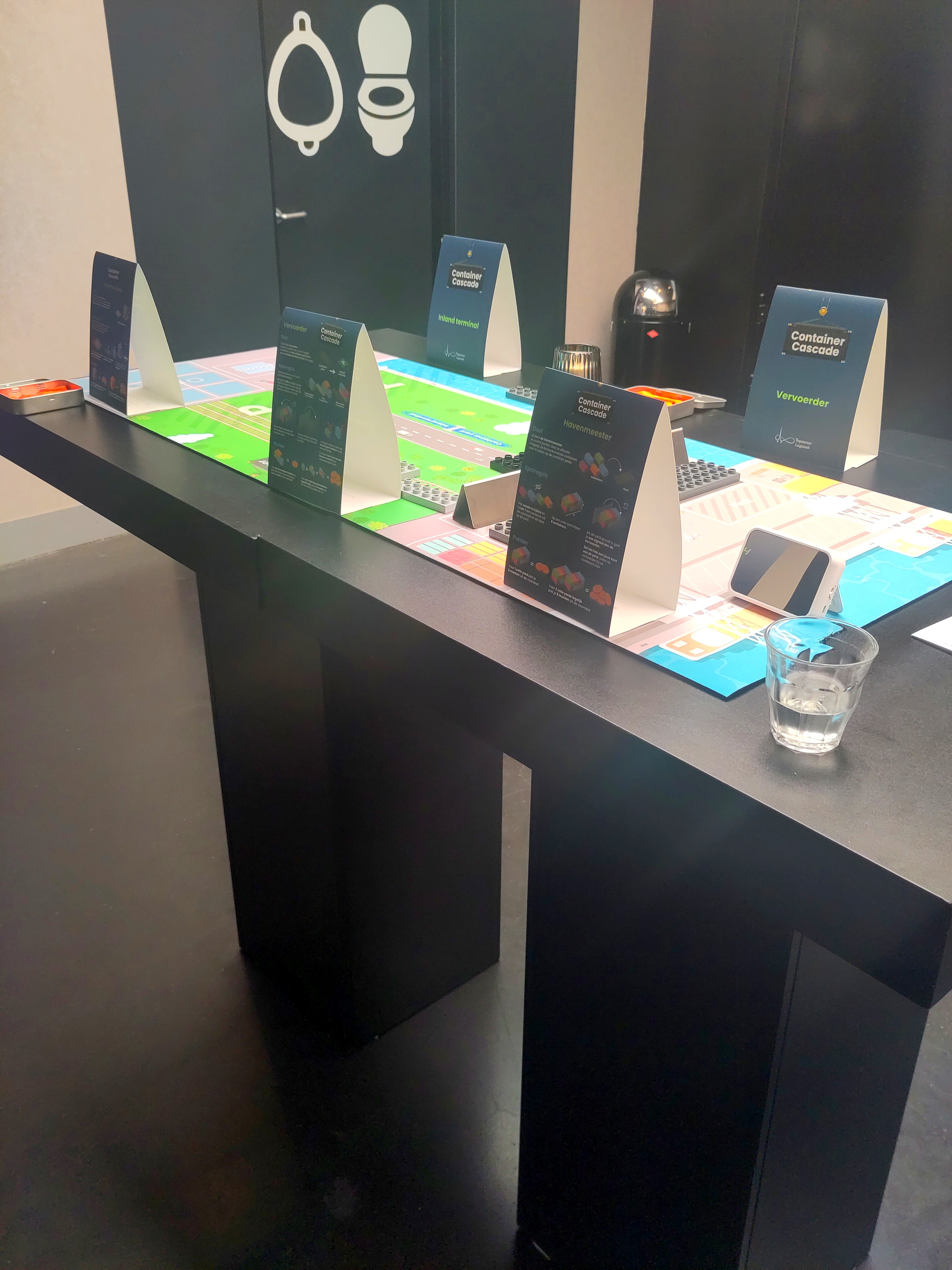
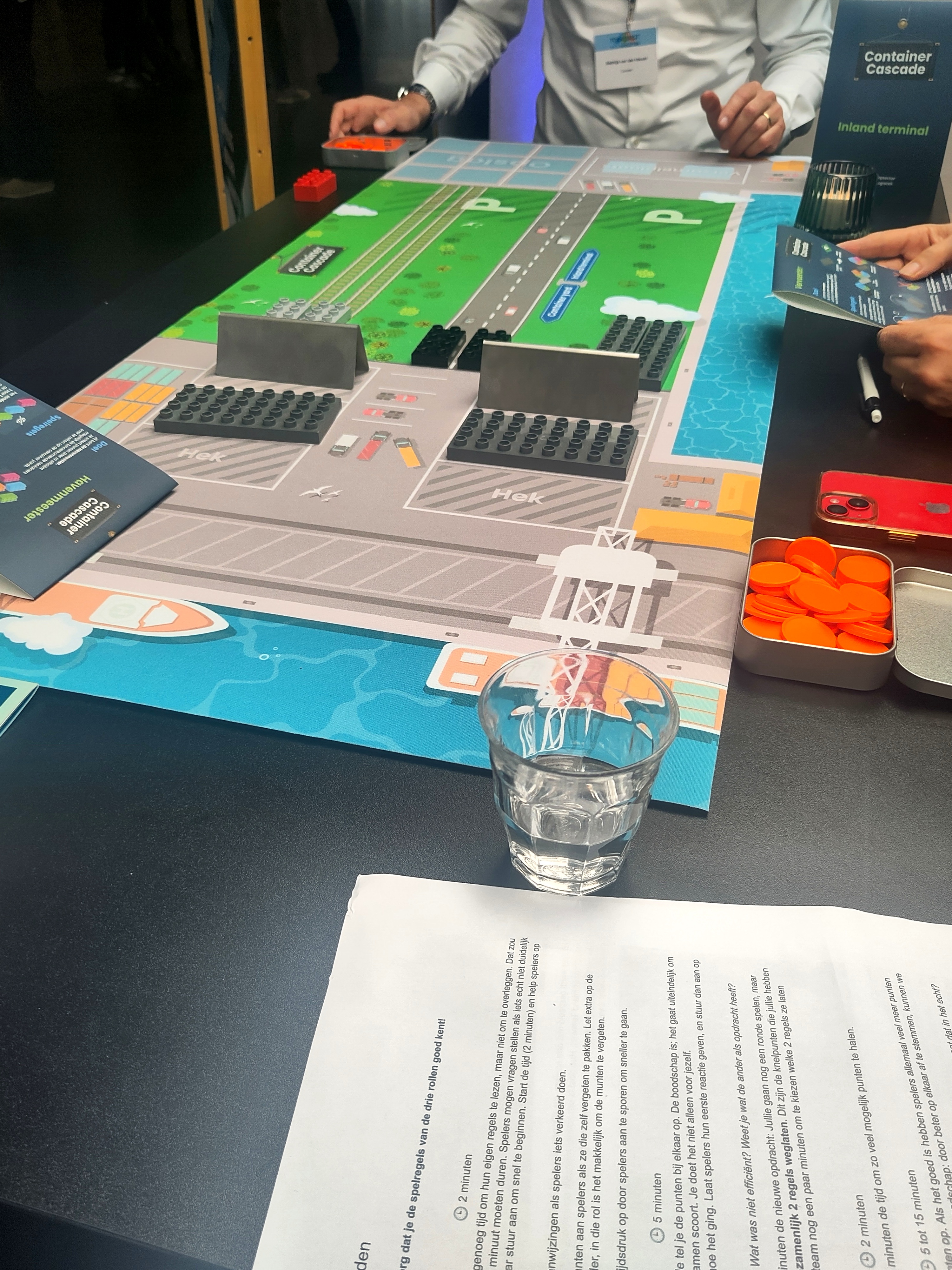
Five roles. Each player runs one link of the chain. You see your own numbers. You do not see the rest of the chain.
| Role | Your job |
|---|---|
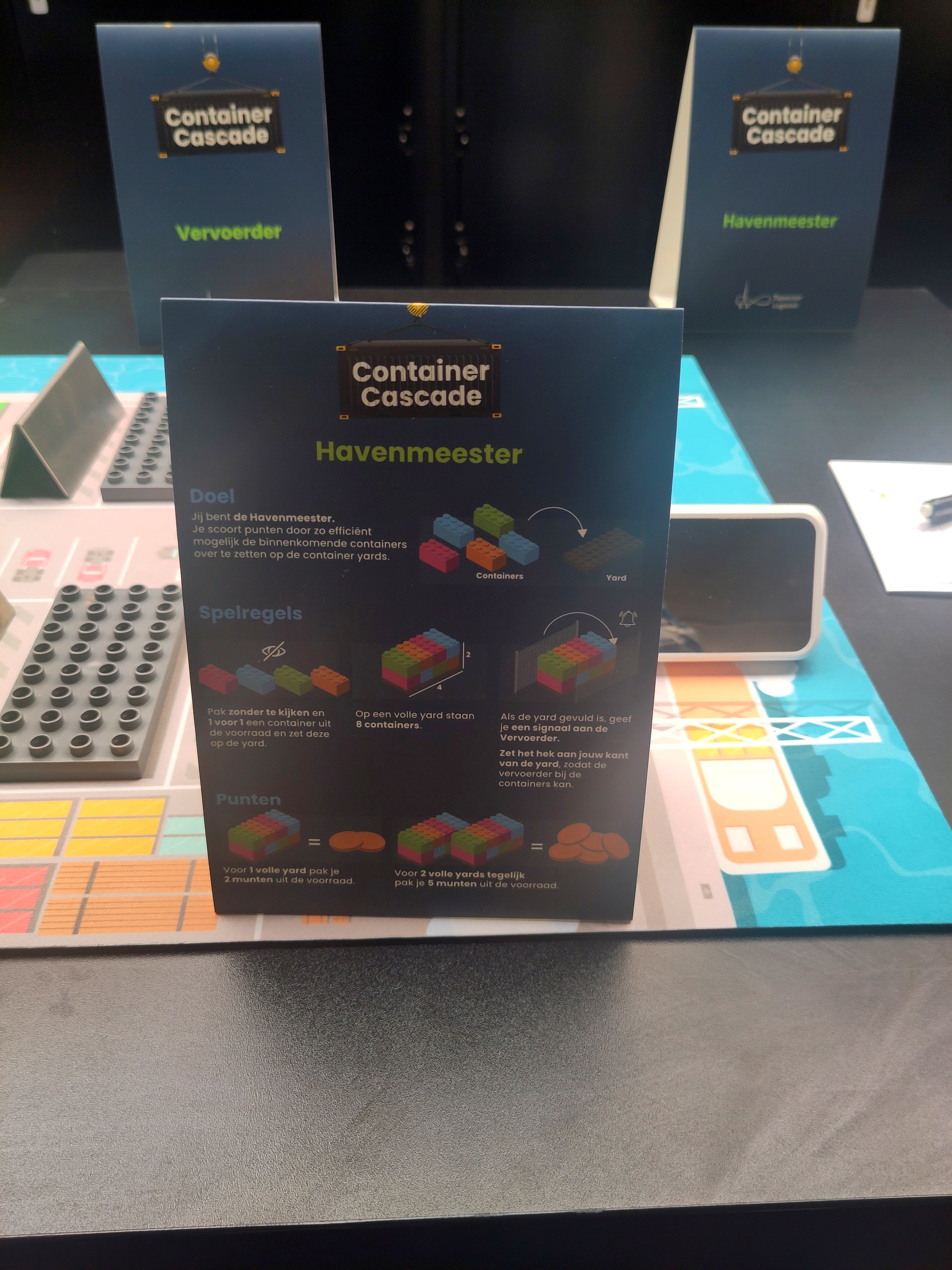
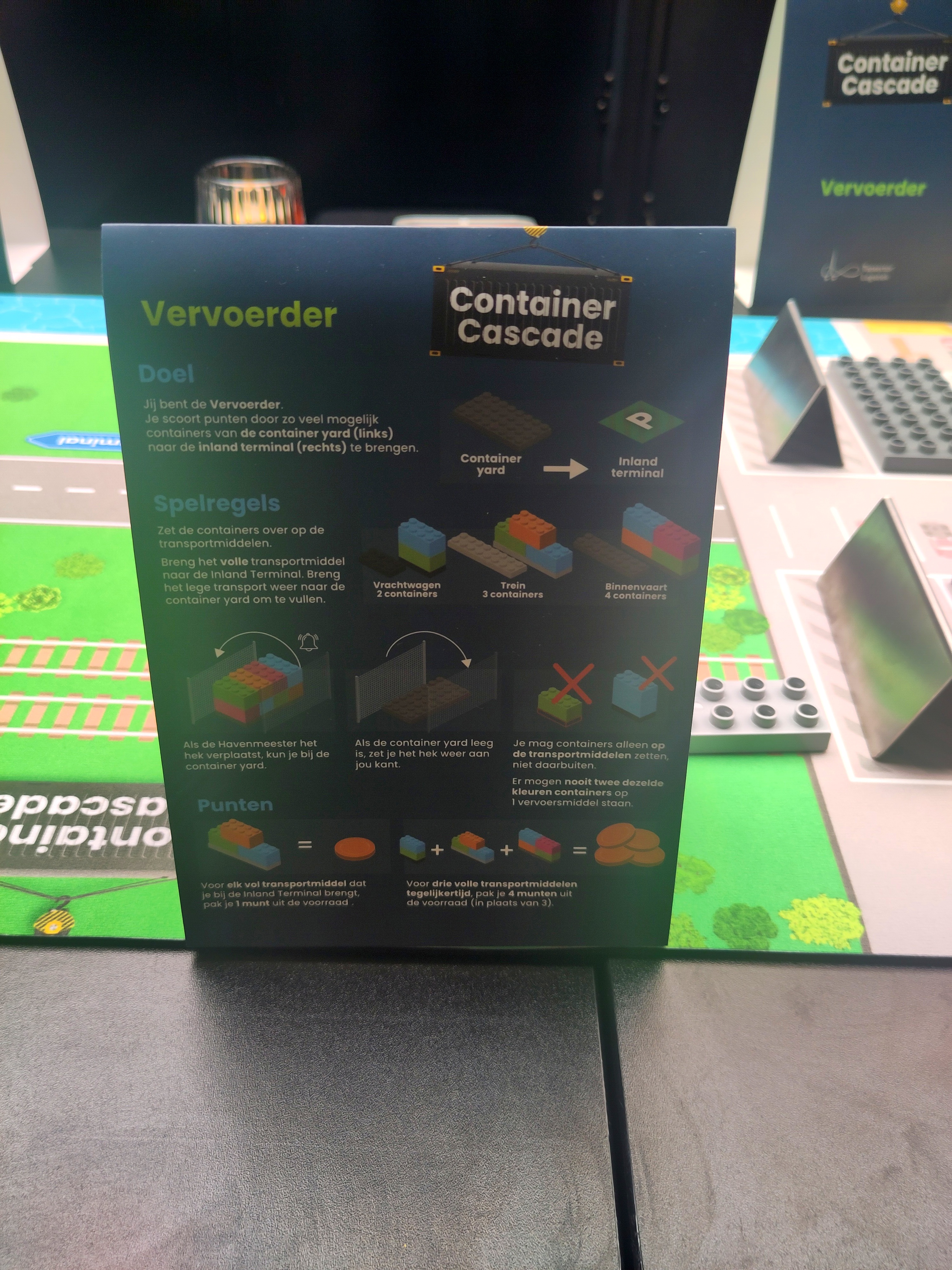
| Havenmeester | Move containers from ship to yard. Keep the yard turning. Signal the Vervoerder when ready. |
| Inland Terminal | Manage arrivals, modality mix, stack allocation. |
| Binnenvaart Operator | Plan departures, manage call frequency, bundle loads. |
| Spoor Operator | Allocate wagons, coordinate terminal windows, manage timing. |
| Vervoerder | Dispatch trucks, book slots, choose your transport mode. |
3 to 6 players per table; smaller groups combine roles. A facilitator runs disruptions and controls information flow between rounds.
Six rounds, three regimes
| Rounds | Regime | What changes |
|---|---|---|
| 1 and 2 | Local optimisation | Each player maximises their own KPI. No coordination mechanism exists. |
| 3 and 4 | Bilateral negotiation | Pairs may share limited information across one interface. |
| 5 and 6 | Chain coordination | A shared planning tool is introduced. Players can renegotiate KPI agreements. |
Every round includes at least one disruption: a late vessel, terminal outage, waterway closure, demand peak, or rail delay. You respond with the authority available in your role.
Two scores run throughout:
- Own score (0 to 100): how your link is performing.
- Chain score (0 to 100): how the total system is performing.
In round one or two, most players post a decent own score while the chain score is poor. That gap is the lesson.
What you take away
After the game, these five things are no longer abstract:
How local optima destroy system performance. You saw it happen. In round two, your score looked fine and the chain was grinding. You know now why those two things can be true at the same time.
How disruptions propagate. One late vessel. Three links still dealing with it two rounds later. The Ripple Effect is not a theory anymore – it is something that happened to your barge schedule.
Why more infrastructure is not the answer. The Betuweroute already exists. The capacity is there. The constraint is somewhere else. You know where, because you spent an hour looking for it.
The three root causes by name. Governance and KPI misalignment. Data gaps between links. Missing coordination for bundling. After the debrief, you have a word for each problem you caused yourself.
What to do first. Not what sounds good in a policy document – what you actually saw matter in the game. The debrief connects your experience to the research so you leave with a prioritised view, not just a list of problems.
The research base grows with each session
Container Cascade is built directly on Productiviteit van de achterlandcontainerketen (Topsector Logistiek, SmartPort, Rebel, 2026). The problems in the game are the problems from the report.
Each session contributes anonymised data back to the research base: per-round KPI scores, disruption responses, and debrief intervention priorities. Over time this shows where coordination breaks down first, which disruption types cause the largest chain-score drops, and what different groups of participants actually learn.
0 participants across 1 play sessions have contributed anonymised data to the Container Cascade research base so far.
Play a session
Sessions run two to three hours including debrief. Works for groups of 3 to 25 participants (multiple parallel tables). Available in Dutch and English.
Book a session for your team, class, or organisation.
Container Cascade is a project of Research Ready, built on research by Topsector Logistiek, SmartPort, and Rebel (2026). Facilitation guide and game materials available on request.